
Workshop & Tools / Tool storage
How to Store Power Tools in a Small Garage
Give each tool, case and accessory a useful home. Plan battery storage separately, keep instructions close and make putting everything away a simple final step.
Researched October 7, 2026 · Household workshop organization · No hands-on product testing.
1. Start with the tools you actually use
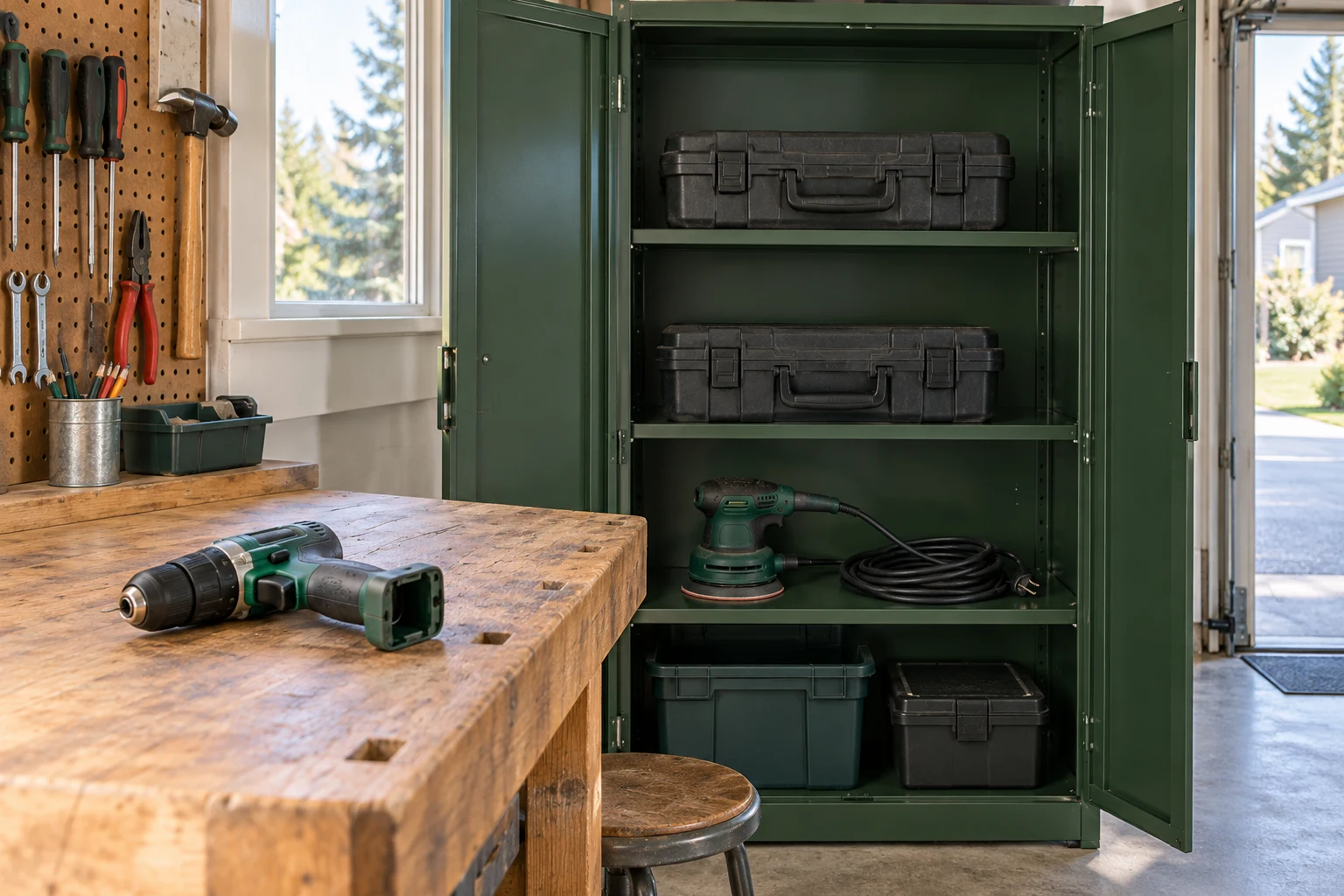
Clear one working surface and list the tools you own. Note whether each is corded or cordless, its model, the case it came with and the accessories needed for your usual tasks. Include the space needed to lift it out, rather than measuring only the tool's footprint.
Divide the collection into frequent-use tools, occasional-use tools and equipment that needs attention. Give the first group an accessible location. Keep occasional tools together with their cases and instructions. Do not place damaged equipment back among ready-to-use tools: CCOHS advises taking defective tools out of service and clearly identifying them for repair by a qualified person.
Before changing accessories or arranging tools for storage, follow the manufacturer's shutdown and power-isolation instructions. CCOHS specifies removing the battery or ensuring a cordless tool is switched off or locked off before storage; disconnect the power supply before adjustments or accessory changes. Keep the exact manual as your reference for the particular tool. Source: CCOHS electric-tool safety.
2. Choose a storage format around retrieval
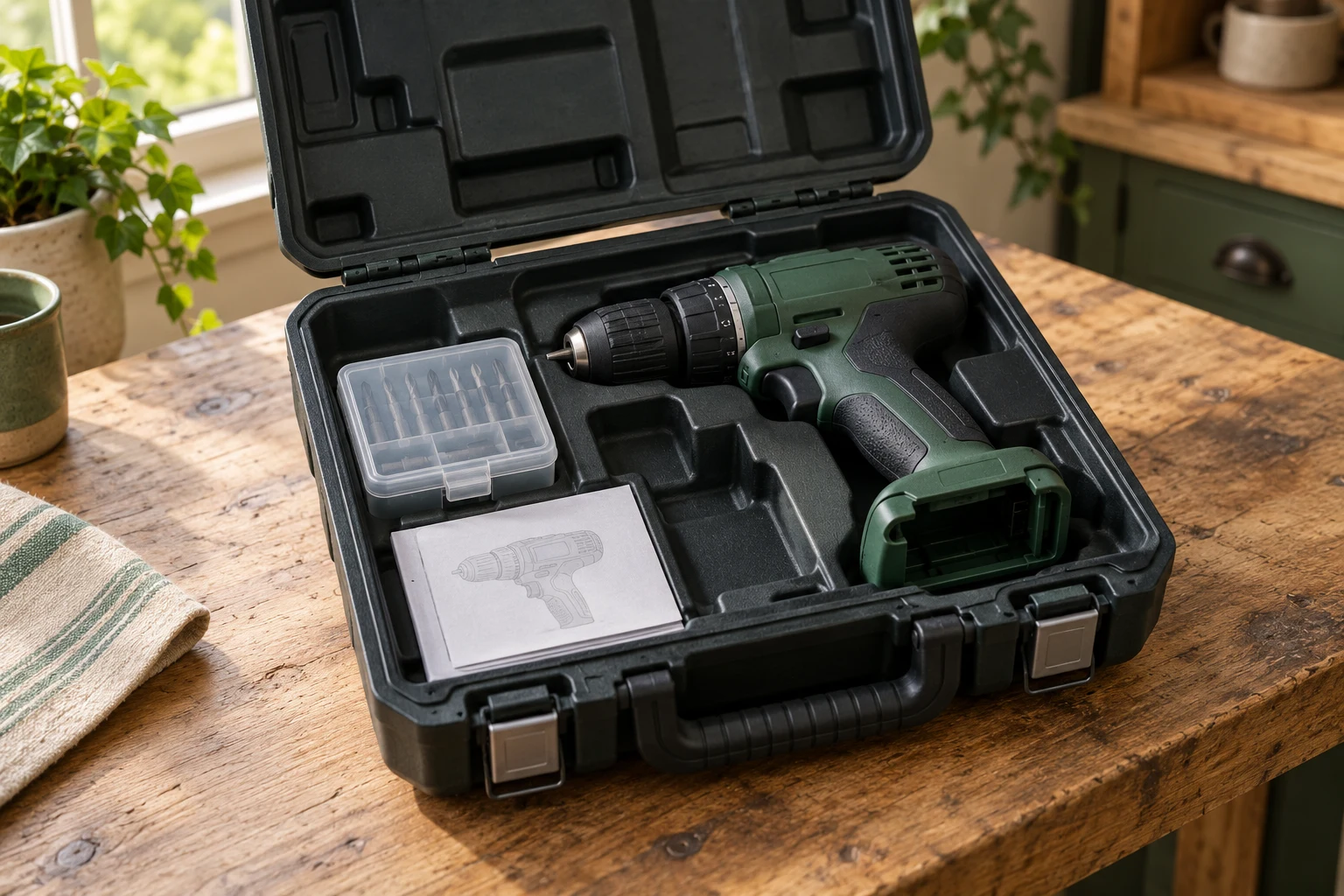
Use an existing fitted case when it keeps the tool and its accessories organized and suits your available space. Check the case's contents before closing it: cables, handles or accessories should not be trapped by the lid. An attractive new organizer is unnecessary if the original case already works.
A drawer can make frequently used compact tools easy to retrieve. Measure usable width, depth and height, including clearance beneath the drawer above. Keep tools stable and leave enough room to grasp their handles. A shelf or cabinet can suit larger cases, provided it supports the load and lets you remove one case without lifting a stack.
| Format | Useful when | Check first |
|---|---|---|
| Fitted case | You move the tool between tasks or use it occasionally | Tool fit, lid clearance and manageable carrying weight |
| Shallow drawer | Compact tools are used at the same bench | Usable depth, load limit and handle access |
| Shelf or cabinet | Larger cases need a permanent home | Support, load limits and clearance for removal |
| Purpose-made wall holder | A compatible holder suits the tool and space | Exact compatibility, mounting instructions and stated load limits |
A wall holder needs more than a resemblance to the tool in a photograph. Follow the exact holder's instructions and use a suitable mounting surface. This guide does not provide mounting specifications or structural calculations. Our wall-storage guide covers the questions to ask before choosing a system.
Keep cords loosely looped without knots or sharp bends, and avoid trapping them under cases or cabinet doors. Carry a tool by its intended grip rather than its cord. Place storage away from wet gear and locations exposed to rain or splashes; CCOHS calls for a dry, secure storage location.
3. Give batteries their own suitable location
Read the storage instructions for each battery platform. Storage temperatures, charging temperatures and long-term care requirements are model-specific; do not apply a universal temperature range or charge percentage to every pack. DEWALT's general safety guidance recommends a cool, dry location for its batteries. Source: DEWALT battery storage and safety tips.
For a Canadian garage, assess actual seasonal conditions. A space that freezes in winter or becomes very hot in summer may fall outside a particular manufacturer's limits. If it does, choose a separate secure location that meets those instructions instead of assuming the cabinet solves the temperature problem.
Keep battery terminals from contacting screws, nails, keys and other metal objects. Use the manufacturer's terminal protection or suitable storage arrangement where specified. Do not put loose packs into your mixed hardware drawer. Keep the model reference readable so you can identify the correct tool and intended charger.
Storage and charging are separate decisions. Use the charger specifically intended for the battery and follow its placement and operating instructions. A shelf shown in an organizing photograph is not a tested charging station. Do not build a charging arrangement from an illustration or assume a closed cabinet is approved for charging.
Inspect packs as instructed. Cracks, leaks or swelling are reasons to stop treating a pack as ready for use and seek the manufacturer's guidance. Do not improvise a repair or place a questionable pack back into normal storage. CCOHS lithium-ion battery guidance supports the terminal, charging and damage checks; the exact product instructions govern further handling.
4. Keep the right accessories beside the right tool
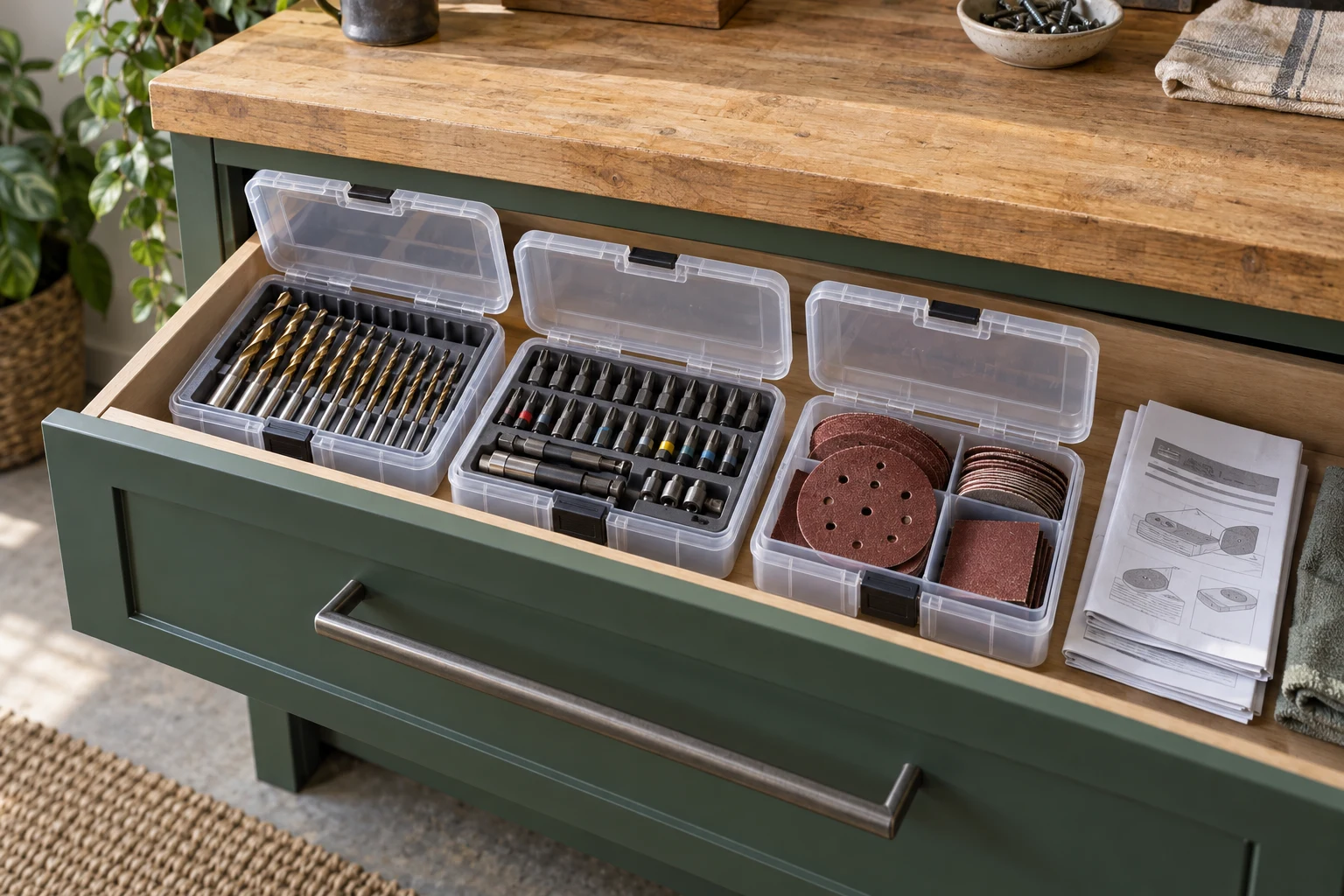
Keep drill bits, driver bits, sanding materials and other accessories in suitable original packaging or fitted containers. Protect sharp edges as their instructions require. Avoid loose blades or pointed bits mixed with cables and handles, where someone might reach in without seeing them.
Preserve labels that identify size, intended material, model compatibility and operating limits. Similar appearance does not establish that an accessory fits or is suitable for a task. A small closed accessory box beside a tool case can make preparation easier while retaining the information you need.
Keep manuals digitally by model number, or store printed instructions in a separate folder. Put adjustment keys in the assigned case compartment or accessory container when the manual allows it. Check that a key or wrench is removed from the tool before use. Our small-hardware guide helps keep project fasteners separate from tool accessories.
5. Make returning tools part of finishing the job
After a task, stop the tool and follow its instructions for disconnecting power, cooling and cleaning. Use only the cleaning method the manufacturer permits. Look for damage to the casing, cord, switches or battery before returning items to their usual locations.
Return the tool, its known accessories and its instructions to their assigned places. Leave defective or unidentified items out of the ready-to-use group. If you regularly find a case left on the floor, simplify access: a shelf that requires moving three other cases is unlikely to support a good routine.
Try the arrangement with your existing storage before buying anything. Measure the remaining gap, then compare dimensions, load limits and the full current cost of any additional drawer, shelf or case. The tool chest and cabinet comparison and small workshop guide help connect tool storage with the surrounding workspace.
Your power-tool storage checklist
Selections work during this visit and are not saved between visits.
Sources and scope
CCOHS electric-tool and lithium-ion battery guidance, and DEWALT battery safety guidance were reviewed October 7, 2026. Storage-format comparisons, inventory suggestions and the return routine are original household organizing guidance. Follow the manuals for your exact tools, accessories, batteries and storage products. The generated photographs illustrate organization only; they are not tested products, charging setups or installation instructions.