Gardens & Growing · Choose before you buy
Watering Houseplants While Away: Pots, Wicks or a Pump?
Match the watering method to the plants you already own, the time you have to test it and the person who can check in while you are away.
Researched November 7, 2026 · Independent planning guide based on published guidance, not hands-on product testing.
Which situation sounds like yours?
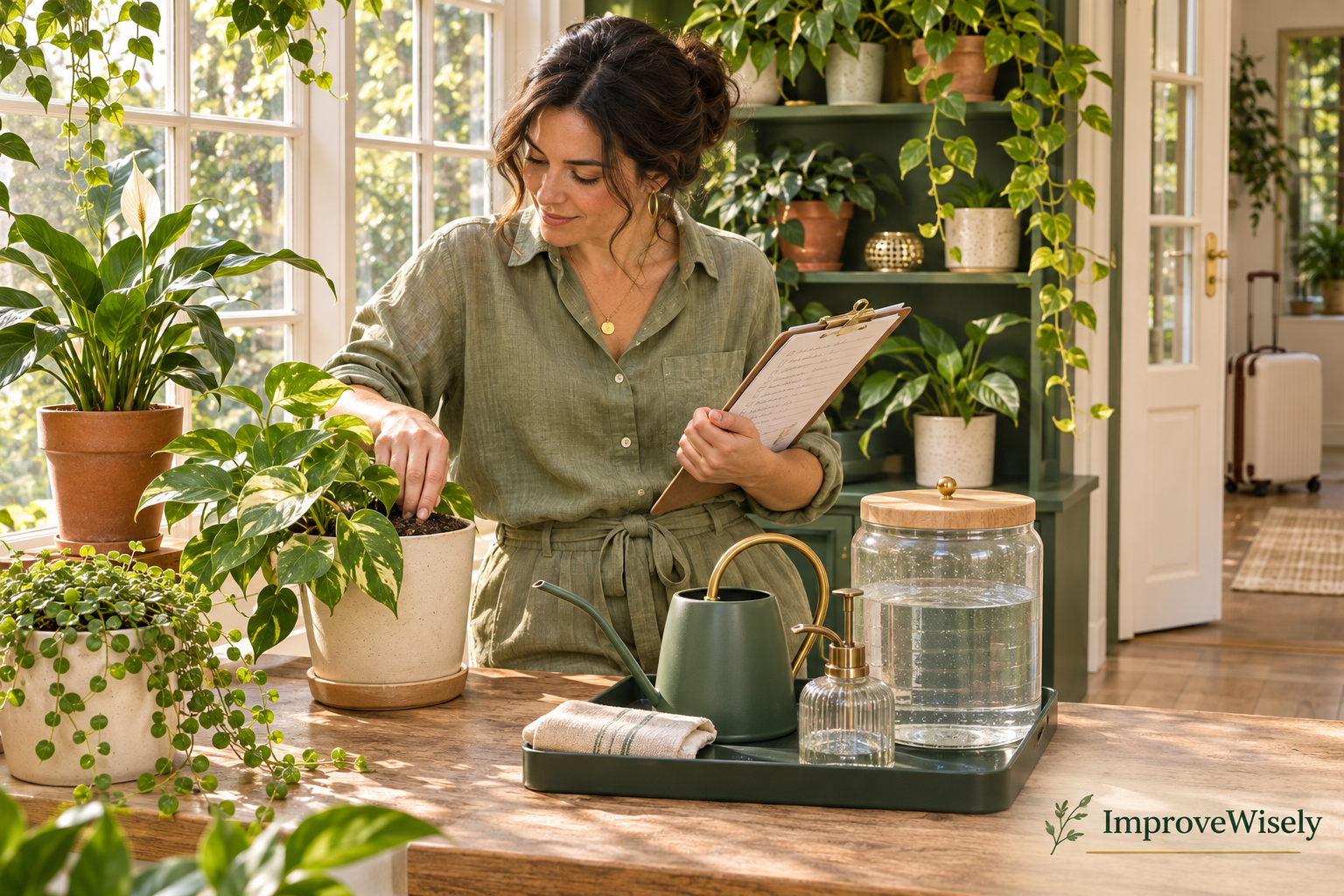
Start by noting your travel dates, plant types, pot sizes and normal watering pattern. A small terracotta pot can behave differently from a large glazed one. The University of Saskatchewan explains why pot material and size matter and recommends trying the method before leaving.
01 / A LONG-TERM CHANGE
Happy to change the planter?
Consider a reservoir planter if you want an everyday system and can allow time for your plant to establish.
Check planter fit →02 / KEEP EXISTING POTS
A few plants, no power?
A wick and reservoir may be worth testing. Check each pot individually rather than assuming identical delivery.
Understand wick limits →03 / A GROUP OF PLANTS
Several pots in one area?
Compare a pump kit if you have a suitable power source, space for a tank and time to set each outlet up.
Check pump controls →Leaving before you can test? Keep an established care routine and arrange a trusted person to help. Buying a more complex kit does not create preparation time.
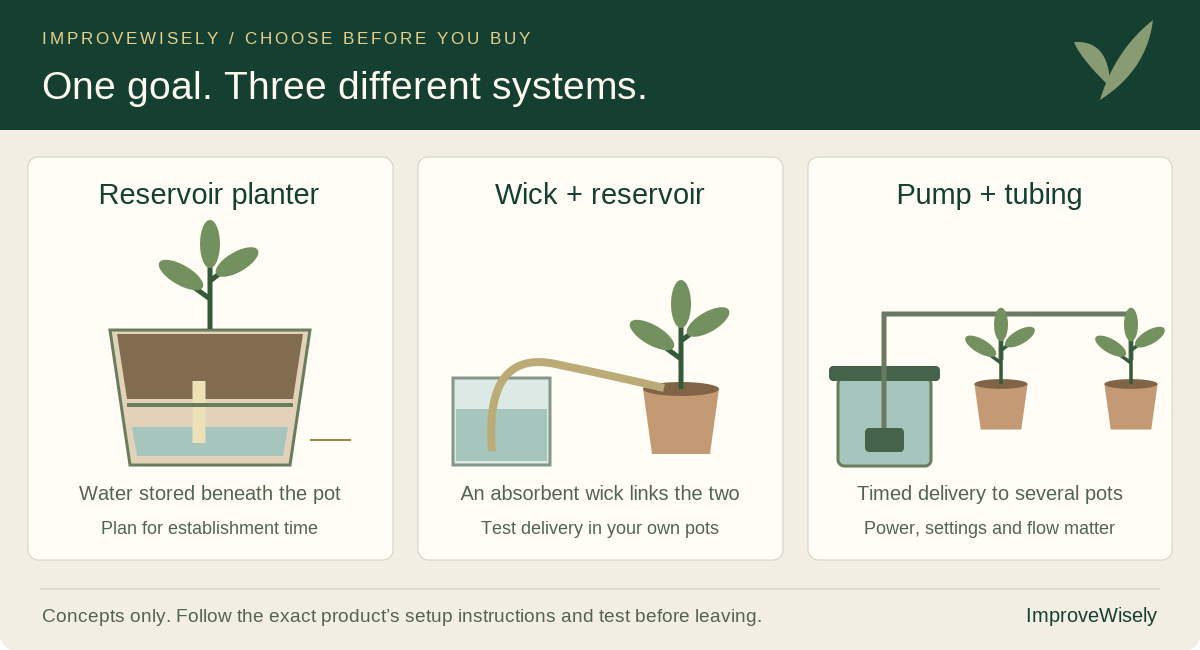
Three systems, different commitments
| Check | Reservoir planter | Wick + container | Pump + timer |
|---|---|---|---|
| Keep existing pot? | Depends on the design; many require a new insert or repotting. | Often possible; the wick must contact the potting mix. | Often possible; tubing and outlets must stay in position. |
| Power | Passive designs need none. | No electrical supply. | Check mains, battery or another specified supply. |
| What you adjust | Planting setup and refill routine. | Wick, reservoir position and contact with the mix. | Schedule and delivery per pot, within the kit’s limits. |
| Main limitation | Establishment time; a poor match for the plant’s moisture needs. | Delivery can be too slow or excessive; wick or water contact can be lost. | Power, tubing, settings and reservoir capacity all need checking. |
| Costs to compare | Planter, insert, substrate and replacement parts. | Suitable wick, stable container and surface protection. | Kit, tank, additional lines, power supply and spare parts. |
1. Self-watering planters: plan ahead
A built-in reservoir supplies moisture from below. The RHS treats these as a long-term growing choice, rather than a reason to repot immediately before a short holiday. Suitability depends on the plant’s moisture needs.
Ask how the plant becomes established, which potting medium is required, how the water level is read, and whether the system needs a dry interval between refills. As one manufacturer-specific example, LECHUZA’s instructions describe an initial period of watering from above, followed by checking that roots can draw from the reservoir. They also explain that a minimum indicator does not automatically mean refill immediately. Follow the instructions for your exact model and plant.
Measure before buying: inner planting dimensions, reservoir volume, access to the refill opening and clearance for lifting the insert. The outside diameter alone will not tell you whether your existing root ball fits.
When to pass: you want a temporary solution for a trip starting very soon, or you have not confirmed that the plant suits the system. An attractive planter is not evidence that it fits your watering routine.
2. A wick and reservoir: simple, but test every pot
A suitable absorbent wick connects a water container to the potting mix. The University of Saskatchewan describes this method using absorbent cord with one end in water and the other tucked into the soil. It does not provide a universal flow rate for every plant.
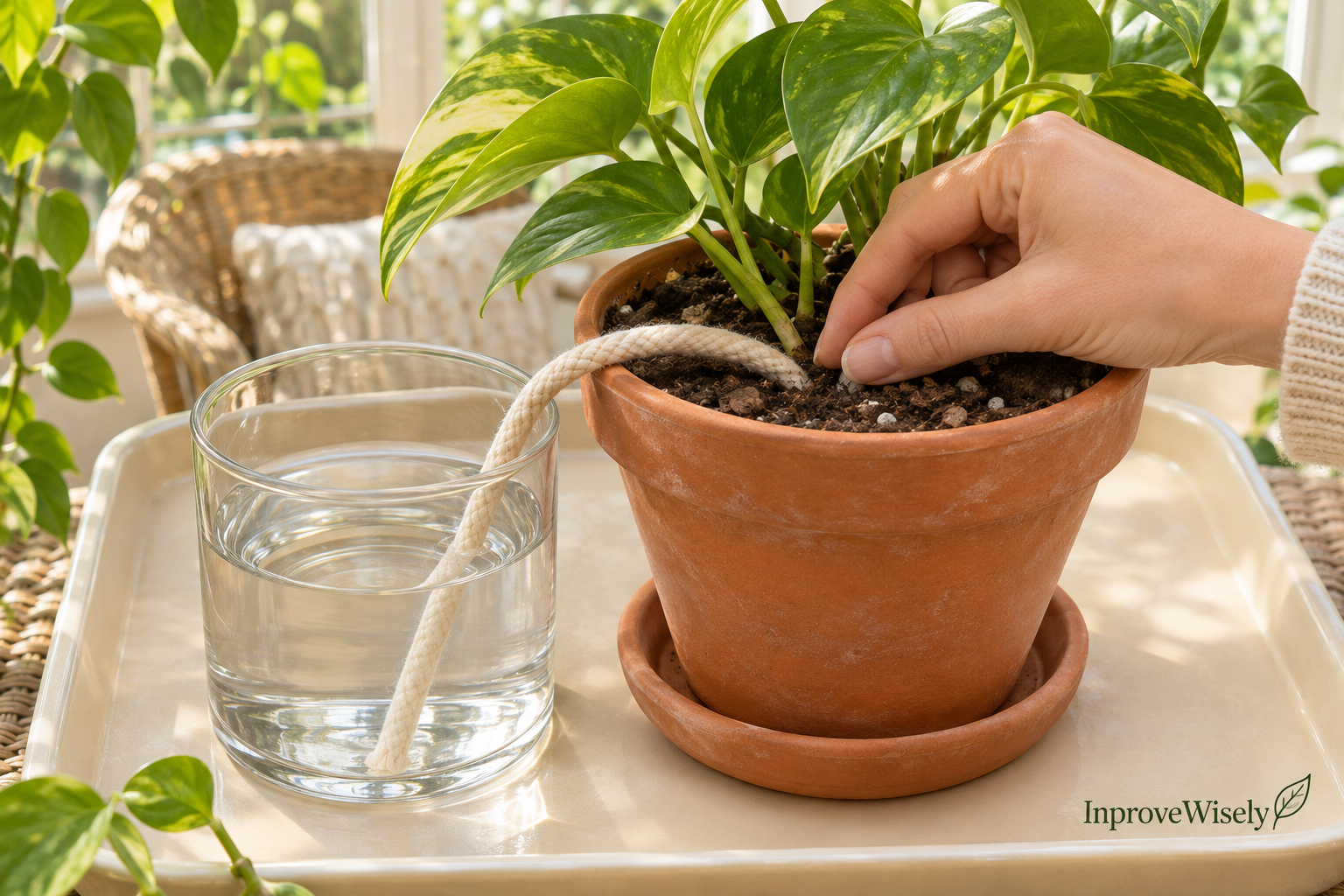
Keep the wick in contact with both water and mix, then observe the pot as the reservoir empties. Record whether the mix stays suitable for that plant, not merely whether the water level drops. Check that the cord stays secured and that the container cannot tip.
Before buying: compare the wick material and length, container footprint, ease of cleaning and refill access. A decorative glass globe, a ceramic watering cone and an absorbent wick are different devices; do not transfer setup instructions between them.
When to pass: your trial leaves the mix too wet or too dry, the container is unstable, or the arrangement cannot be protected from pets and accidental movement. Cacti and succulents should not be assigned continuous moisture simply because another houseplant uses it.
3. A pump and timer: inspect the controls
A pump moves water from a tank through tubing to individual pots. Check the usable number of outlets, maximum tubing reach, power requirements and whether outlets can deliver different amounts. Count usable outlets for your layout rather than treating the advertised plant count as a guarantee.
“Automatic” does not always mean fully programmable. For example, the GARDENA Holiday Watering Set 13366-20 describes a one-minute daily cycle, three distributor delivery rates, mains power and a 10.5-litre reservoir. That is a specific control arrangement, not an app-based moisture sensor. This is an example of reading specifications, not a tested product recommendation.
Ask what happens after a power interruption or an empty reservoir. Follow the maker’s instructions for tank height, tubing routing and any anti-siphon measures. Keep electrical connections away from water and protect the surface beneath the installation. Inspect the system while it runs and after it stops.
When to pass: the minimum dose is too much for a small pot, the schedule does not suit your plants, or you cannot test and monitor the entire layout before departure.
 improvewisely.com
Plant care · Travel planning worksheet
A trial run is more useful than a “days away” claim
ImproveWisely’s suggested planning worksheet: test the complete arrangement in its intended location over several watering cycles before relying on it. This is an observation plan, not a claim that any fixed test length guarantees success.
- Record the starting point. Note the plant, pot size, usual care, reservoir level and planned time away.
- Check actual delivery. Inspect every pot, connector and surface. A dropping reservoir alone does not prove correct watering.
- Repeat after adjustments. If you change a wick, timer, outlet or location, observe the revised setup again.
- Arrange a backup. Leave a contact person clear, plant-specific instructions and a way to check the system.
The University of Florida’s vacation-care guide highlights the value of a plant sitter, particularly for longer absences: irrigation alone does not address pests or other problems.
| Date / plant | Water level / settings | Mix and plant condition | Leaks / changes / next check |
|---|---|---|---|
| Start: | |||
| Check 1: | |||
| Check 2: | |||
| Check 3: |
Use your trial to judge refill needs under those conditions. Allow for changed temperature, light, plant growth and delays to your return. Reservoir volume by itself cannot predict a safe number of days away.
ImproveWisely · improvewisely.com · Personal planning worksheet, not a watering prescription.
Check these before you buy
Questions worth asking
Will a bigger reservoir solve the problem?
It increases stored water, but does not correct excessive delivery, poor contact, unsuitable scheduling or leaks. Check the whole system.
Should I change the plan for winter travel?
Base the decision on the plants and their actual indoor conditions. The RHS discusses winter care separately. Heated rooms and grow lights can differ from a cool winter room; do not use the calendar as your only guide.
Can I put every plant on one schedule?
Only if observation and the kit’s controls support their different needs. Grouping pots for convenient tubing is not the same as matching their water requirements.
Build a more practical plant corner
Check shelf space and lighting with our grow-light measurement guide and electricity calculator, or compare small-space winter-growing options before buying more equipment.
Sources and scope
Sources linked above were checked on November 7, 2026: RHS, University of Saskatchewan, University of Florida, LECHUZA and GARDENA. Manufacturer examples describe the named system only. The comparison framework, shortlist and trial worksheet are ImproveWisely’s editorial planning tools. We have not tested these products. Photos are generated concepts; the diagram is original. Use plant-specific advice and exact-model instructions when setting up your system.